|
Future SLPs is honored to have our first guest blogger, Jena H. Casbon, MS CCC-SLP.
I hope you enjoy reading this post as much as I did! Private Patients: A Great Opportunity for SLP's Experiences During School Will Prepare You For... It never ceases to amaze me how rich and diverse the field of Speech-Language Pathology is. Many incoming and early graduate students tend to think of our field in terms of:
Your Clinical Fellowship and Early Career The 9-month clinical fellowship (CF) that will follow graduation is a both stressful and liberating time in your career. In many ways, you are on your own now: able to work on the areas where you feel your patient needs the most help. This degree of autonomy can be scary for many CF's but hopefully your supervisor, colleagues or former graduate school classmates can support and encourage your clinical decision making. During the first few years of your career as a Speech-Language Pathologist you will continue to learn so much about disorders, how patients can present differently, how to manage patients and family dynamics, etc. At this stage you will likely begin to gravitate to a specific age group, diagnosis, etc. I urge you to take as many continuing education courses (CEU's) as you can as you build your expertise. You may even opt to change jobs or settings in order to gain more exposure to different aspects of our field. All of these things will help you to grow and provide excellent care for your patients. I Wonder If I Could Ever Have A Private Practice...? Almost every SLP friend of mine started out dreaming one day of having a private practice- but as they got into the field more and more, the safety of a regular job with consistent pay won out over the risk of going out on their own. To be honest, starting a private practice has a lot of extra work, extra responsibilities and headaches- but the trade off of high-income and more autonomy is very alluring for some people. Private Patients: A Great Way to Start Most of us got into this field because we love to help people, not because we wanted to make money. As time goes by though, the reality of car or house payments, wanting to have extra income for our families, vacations, etc. starts to hit and we become frustrated with our regular pay. Another benefit to private patients is flexibility of your schedule and also getting to treat ideal patients. Treating privately is a great way to help more people while making more money by seeing one to several private patients on the side. How Does Private Therapy Work? At some point, you will know colleagues that are treating private patients and a patient or family member will ask if you can provide private treatment. Private speech therapy is often requested as a way to deal with:
Is Private Therapy Right For You? I recommend that you have at least 2-3 years experience as an SLP before you begin treating privately. You need to build up your expertise in a diagnosis or treatment technique so that your services are truly valuable to your private patients. Because you'll be doing this on your own, you need to develop a level of confidence about both your clinical and business skills before you start. Starting to see private patients is almost like your CF all over again. Once you have some practice and experience, you'll feel much stronger. Some clinicians start with private patients and then graduate to starting their own free-standing private practice- others keep their regular job and see private patients on the side. I hope this has helped open your mind to yet another really cool aspect of the field of Speech-Language Pathology! ________________________________________________________________________________________________ Jena H. Casbon, MS CCC-SLP is a Speech-Language Pathologist and founder of The Independent Clinician. After graduating from Emerson College in 2005, she has worked with adult outpatients in a rehabilitation hospital and inpatients in a skilled nursing facility. Three years into practicing as an SLP, she began treating private patients- but the lack of a "how-to guide" bothered her, so she wrote one. Follow Jena on Twitter @IndClinician and Facebook http://www.facebook.com/independentclinician Be sure to visit http://www.IndependentClinician.com to learn more about how to treat private patients.
3 Comments
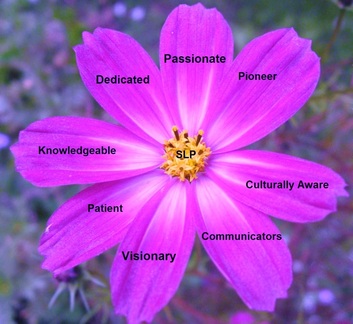 I wanted to write this Blog entry for a while now, but I really wanted to take the time to develop the appropriate wording to really inspire, motivate, and capture the essence and the unique role that a Speech Language Pathologist (SLP) portrays in the lives of others.
In an ever-changing world full of a diverse group of individuals, it is important to be aware of different cultures. As a Speech Language Pathologist, one has to be culturally aware in order to lay a foundation that promotes effective communicators when engaging with others from various cultural backgrounds. Visionary is a powerful word that drives the work that an SLP does on a daily basis. We are patient enough to take the time to see the potential within each client, strategize our plan of action and then make the vision reality. Education, research, and collaborating with other professionals allow speech pathologists to become knowledgeable in an array of areas within the field. Speech Pathologists are dedicated individuals who are passionate about what they do which makes each contributor to this field a pioneer. The Petals of a Speech Language Pathologist will continue to bloom each day, with the proper tools in hand to nurture each plant!  I was inspired to write this post after a beautiful walk this morning. I enjoy walking, it really helps for me to clear my mind, reflect, and brainstorm. As I was walking today,I thought about the risks that I took to get to where I am today. I could not be happier, although I am over 800 miles from home and I miss my family and friends very much, it is all part of the new chapter in my book of life! I think it is so important to step out of your comfort zone sometimes and "take a risk!"
I stepped out of my comfort zone and took a risk when I moved to a new place, created this website, tried a different therapy approach with some of the kids that I work with in the schools, and the list goes on...Risks do not have to be extreme, they can be as simple as trying something you never have done before, opening your mind up to trying new approaches, or whatever task is outside of your comfort zone. Listen to your intuition, follow that gut feeling you get, open yourself up to new opportunities, go into a new opportunity with an open mind and do not be afraid to step outside of your comfort zone and take a risk. The next chapter of your book is waiting to be filled with all of the experiences, knowledge, and wisdom that you gain from "taking risks." Have a great weekend!! Continue to pray and keep Japan in your thoughts,my prayers go out to all families, victims, and survivors affected by this tragedy! "Progress always involves risks. You can't steal second base and keep your foot on first." ~Frederick B. Wilcox~  ► I would highly suggest purchasing the ETS e-book Speech Pathology practice test, to take after you have read and reviewed the information for the test. I think it is good to have because it provides you with good study tips and tips for when you get stuck on a question. Also the format of the questions on that practice test was very similar to the questions on the actual test.
► Determine which environment you study best in and the setup that works best for you. Example: I work best in a space that is uncluttered and I enjoy listening to instrumental music. ► I would suggest taking it easy two days before the test and not looking at test related information two days prior to taking the test, just make sure you rest up. ► The day of the test do not forget to have your admission ticket, be there early, bring two #2 pencils, maybe even an extra pencil (sometimes they do not have extra pencils) and dress warm (it can be very cool in a lot of the testing classrooms).
|
 This work is licensed under a Creative Commons Attribution-NonCommercial-NoDerivs 3.0 Unported License. |
© Copyright 2010-2020 futureslps.com All Rights Reserved Worldwide